

Machine Tending with NACHI Robots for Smarter Automation
Updated: 6 days ago
A CNC machine sitting idle is not just quiet; it is costing money. The spindle may be ready, the part program may be proven, and the next blank may be waiting in a tray. If no one is there to load and unload parts, production stops.
That is why machine tending has become one of the most practical uses for industrial robots. It solves a clear problem: repetitive loading, unloading, door opening, part handling, and cycle starting. NACHI robots fit this work well because they are built for repeatable motion, compact production cells, and long-running factory environments.
For manufacturers looking to reduce idle time, improve consistency, and make better use of skilled labour, Machine Tending with NACHI Robots for Smarter Automation is less about replacing people and more about removing the most repetitive part of machine operation.

Why machine tending is a smart first step for robot automation
Machine tending is often one of the easiest robot applications to justify because the task is clear, repeated, and measurable. A part moves from a tray, bin, conveyor, or chute into a machine. The machine does its work. The robot removes the finished part and prepares the next cycle.
That pattern appears across many common processes:
CNC milling and turning
Grinding and deburring
Injection molding
Stamping and press work
Die casting
Washing, gauging, and inspection stations
The work can be physically demanding, especially when parts are hot, oily, sharp, or heavy. It can also be monotonous. Operators may spend long stretches opening doors, clearing chips, loading blanks, starting press cycles, and stacking finished parts.
A robot does not get distracted during repeatable handling. It can place a part in the same position hundreds or thousands of times. That repeatability helps protect quality, especially when part orientation matters.
The real value shows up when the machine keeps running more often. A high-value CNC machine should cut metal, not wait for someone to return from another task. When a NACHI robot handles tending, operators can focus on setup, inspection, tooling, material flow, and process improvement.
The best applications aren't always the most complex. They are often the ones with steady volume, a repeatable part family, and a clear gap between machine capacity and labour availability.
What makes NACHI robots a strong fit for machine tending-Smarter Automation
NACHI has a long history in industrial robotics, and its robots are commonly used in factory automation, material handling, welding, palletising, and machine loading. For tending work, the main strengths come from motion control, reach options, controller integration, and the ability to work inside compact layouts.
A machine tending robot must do more than move from point A to point B. It needs to handle small position changes, clear doors and fixtures, avoid clamps, wait for machine signals, and recover safely if a cycle is interrupted.
Several traits matter in a tending cell.
Repeatable motion supports consistent part loading
A slight misalignment can cause a bad clamp, a damaged part, or a machine alarm. Robots help reduce that risk by following taught paths with repeatable motion.
In a CNC lathe cell, for example, the robot may need to:
Pick a raw blank from a tray
Present it to an air blowoff station
Load it into the chuck
Confirm clamp status
Close the door
Wait for machining to finish
Remove the completed part
Place it into a finished goods tray
Each move must happen in the right sequence. The robot, machine tool, sensors, and gripper must work together. NACHI robots can be integrated into this kind of controlled routine through common factory signals and robot programming practices.
Compact cells help save floor space
Many plants do not have open floor space to add a large automation cell. The robot may need to sit close to a machine, between two machines, or on a riser beside an existing line.
A six-axis robot is useful because it can reach around obstacles and approach parts from different angles. This matters when machines have sliding doors, chucks, vises, or fixtures that limit straight-line access.
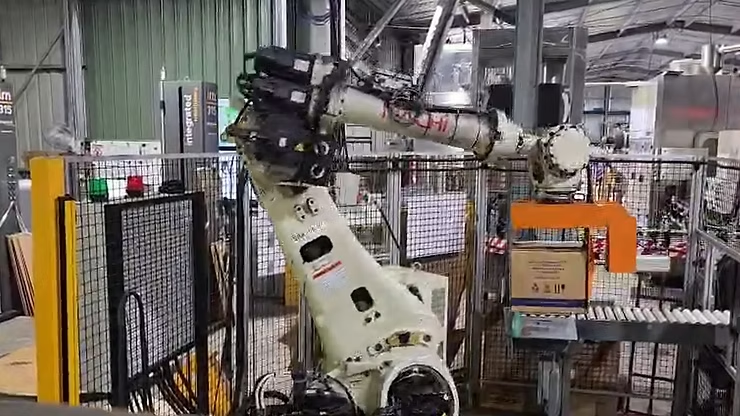
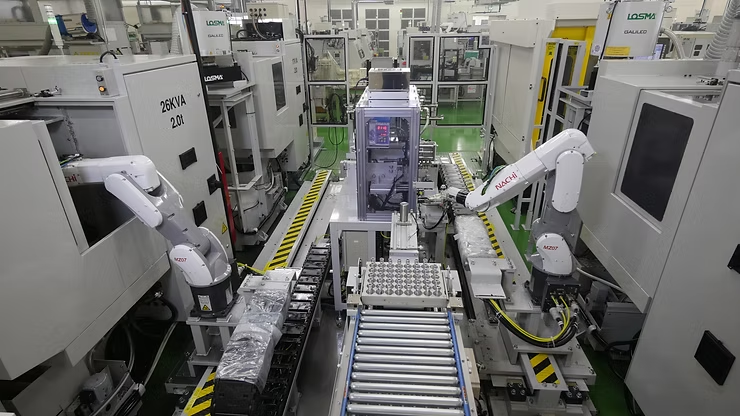
NACHI MZ Small-Payload, Medium-Payload, and SRA articulated robots are ideal for machine-tending applications. The right choice depends on reach, payload, part shape, and the available space around the machine.
Controllers and cell devices must communicate clearly
A good tending cell needs clean communication between the robot and the machine. The robot must know when a door is open, when a cycle is complete, when a part is clamped, and when it is safe to move.
Common cell devices include:
Cell component | What it does |
Robot controller | Runs the robot program and coordinates motion |
Machine tool interface | Shares ready, cycle complete, alarm, and safety signals |
End-of-arm tooling | Grips, supports, or locates each part |
Part presentation system | Feeds raw parts and collects finished parts |
Sensors | Check part presence, grip status, door position, and orientation |
Safety system | Protects people through fencing, scanners, interlocks, or light curtains |
The robot is the most visible part of the system, but the full cell only works when every device supports the process.

How a NACHI machine tending cell works in practice
A well-built machine tending cell follows a clear flow. The robot does not simply copy what an operator does by hand. The process gets shaped so the robot can run reliably with fewer interruptions.
A typical cell starts with part presentation. Raw parts need to arrive in a known position or in a way the robot can identify. This may be a tray with pockets, a conveyor, a bowl feeder, a stack, or a bin with vision guidance.
Tray-based systems are often the simplest for machined parts. Each blank sits in a known location, so the robot can pick parts without searching. For mixed parts or less orderly loading, machine vision may help identify shape, position, or orientation.
Next comes the loading step. The robot approaches the machine, opens the door if needed, and places the part into the fixture, vise, or chuck. The machine confirms that the part is clamped. Then the robot moves clear and starts the cycle.
During machining, the robot can wait or perform another task. In higher-use cells, one robot may tend two machines if cycle times allow it. For example, the robot can unload Machine A while Machine B is cutting, then switch back when the cycle ends.
When machining finishes, the robot unloads the part and may pass it through extra stations:
Air blowoff to remove chips or coolant
Gauging to check a critical dimension
Marking for traceability
Deburring for edge cleanup
Washing before packing
Sorting between accepted and rejected parts
This is where machine tending becomes more valuable. The robot can connect several small steps into one controlled flow. That can reduce manual touches and help keep parts organised.
Tooling often decides the success of the cell
End-of-arm tooling deserves careful thought. A robot with the wrong gripper will struggle, even if the robot itself is well matched.
The gripper needs to account for:
Part weight
Surface finish
Heat
Oil or coolant
Sharp edges
Dimensional variation
Grip points that will not damage the part
Many tending cells use dual grippers. One side removes the finished part, and the other side loads the next raw part. This reduces machine door-open time because the robot does not need to leave the machine between unloading and loading.
For delicate parts, soft jaws or custom fingers help protect surfaces. For castings or forgings, stronger gripping and part location features may be needed. If chips or coolant interfere with gripping, air blast and sensors can reduce mispicks.
Safety design cannot be added at the end
Machine tending includes moving robots, automated doors, rotating spindles, clamps, sharp parts, and sometimes hot material. Safety design must be part of the cell from the start.
A safe system may use fencing, interlocked gates, area scanners, light curtains, safe zones, and controlled restart procedures. The right setup depends on the risk assessment, machine layout, part flow, and how people interact with the cell.
A safe robot cell should make normal work easier, not harder. Operators still need access for setup, tooling changes, maintenance, and inspection. Good design keeps those access points clear and predictable.

Where NACHI robot tending brings the most value
Robot tending is not the right answer for every machine. It works best when the process has enough repeatability and volume to support automation.
Good candidates tend to share a few traits:
Parts repeat across multiple shifts or orders
The machine cycle is long enough for the robot to complete handling steps
Raw parts can be presented in a controlled way
The fixture or chuck is automation-friendly
Quality checks can be built into the process
Operators spend too much time on repetitive handling
Short runs can still work if changeovers are planned well. That may mean quick-change gripper fingers, recipe-based robot programs, adjustable trays, or modular fixtures. Without that planning, changeover time can eat into the benefits.
The biggest gains often come from long or unattended runs. A robot can keep a machine cycling during breaks, shift changes, or periods when operators are managing other equipment. Some facilities use robotic tending to support lights-out or low-attendance production, though it requires reliable machines, stable tooling, chip control, and a clear alarm plan.
Quality can improve too. Manual loading can vary from person to person, especially over a long shift. A robot applies the same motion and placement pattern every cycle. Combined with sensors and gauging, that consistency can help catch problems before they spread.
There is also a workforce benefit. Skilled operators are hard to find and harder to keep when their day is filled with dull handling tasks. Robotic tending lets experienced people supervise more value-added work: setup, inspection, troubleshooting, and process control.
How to plan a stronger NACHI machine tending project
The best automation projects start with the process, not the robot model. Before choosing reach, payload, or cell layout, map the full cycle as it works today.
Watch the machine run. Time the manual steps. Note every small action the operator takes, including the ones that seem obvious. Those details often determine whether the robot cell runs smoothly.
Key questions include:
How does the operator know the part is seated correctly?
What happens when chips build up?
How often does the tool need adjustment?
Where do rejected parts go?
How often does the machine alarm?
What part variations must the cell handle?
How will someone restart the cell after a stop?
A robot can be very reliable, but it cannot fix an unstable process by itself. If parts arrive in random positions, fixtures wear unpredictably, or the machine alarms often, those issues need attention before or during automation design.
Start with a manageable scope. A single-machine tending cell with a stable part family can prove the approach and teach the team what works. From there, it becomes easier to add inspection, multiple machines, or more part numbers.
Training also matters. Operators and maintenance staff should understand how to recover from common faults, change tooling, load trays, and read cell status. The goal is not to make the system mysterious. The goal is to make it clear enough that the team can run it with confidence.
A practical project plan should include:
Define the parts and cycle goals
Review the machine interface and safety needs
Choose part presentation and gripper design
Simulate reach, clearance, and door access
Build and test the robot sequence
Train operators and maintenance staff
Track uptime, scrap, and manual intervention after launch
That last step is easy to skip, but it matters. Real production data shows whether the cell is doing what it was built to do. It also points to small changes that can make the system more reliable over time.

The takeaway for smarter machine tending
NACHI robots can make machine tending more consistent, more productive, and easier to manage when the application is chosen well. The strongest projects pair the right robot with the right gripper, part presentation method, safety design, and machine interface.
The payoff is straightforward. Machines spend more time running. Operators spend less time on repetitive loading. Parts move through the cell in a controlled flow. Production becomes easier to repeat from shift to shift.
Smarter automation starts with one clear question: where is a good machine waiting on a human hand for the next part? If that wait happens often, a NACHI robot may be the practical next step.
Comments